Table of Contents
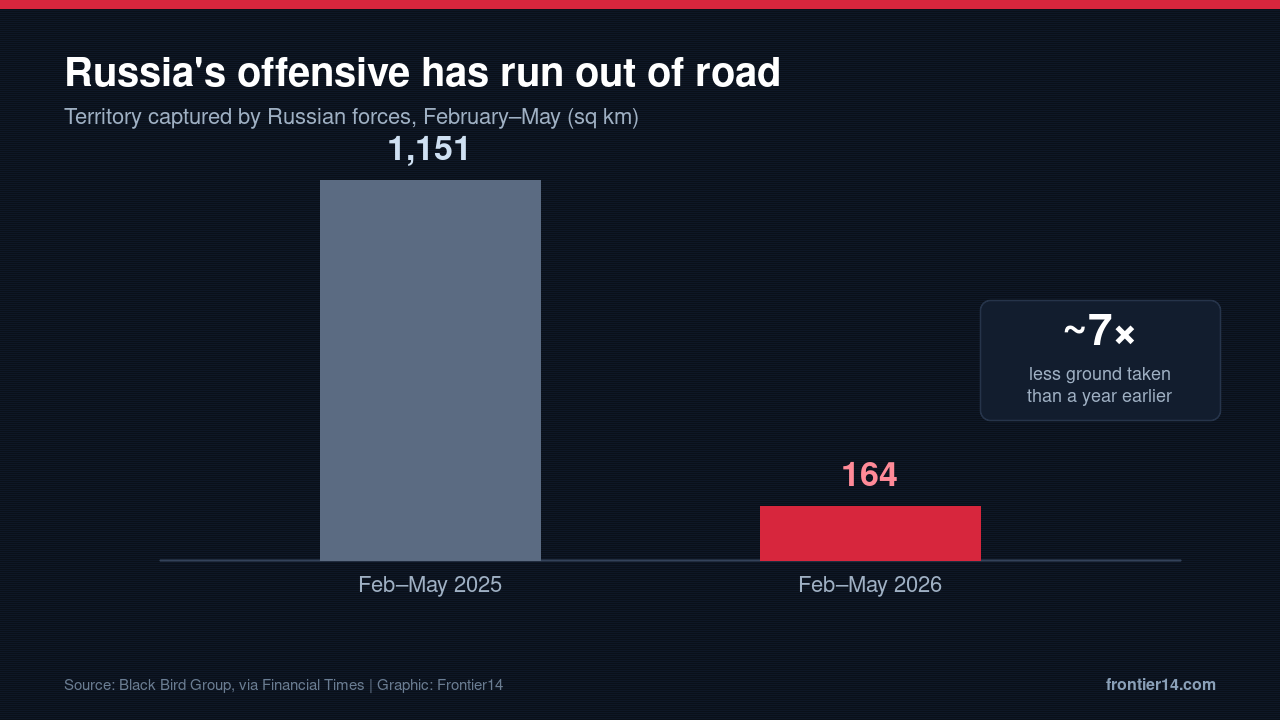
The clearest measure of how Russia's war is going is not a map. It is a ratio.
Between February and May, Russian forces captured around 164 sq km of Ukrainian territory, according to the Finnish monitoring group Black Bird Group. Over the same months last year, they took 1,151 sq km, roughly seven times more. Russia's offensive usually dips in late winter and revives in May. This year it has not revived. As of mid-June, advances have shown no sign of resuming across most of the front.
That single comparison reframes everything else. Russia is not winning faster; it is grinding slower, and paying more for less.
The drone war has changed the maths
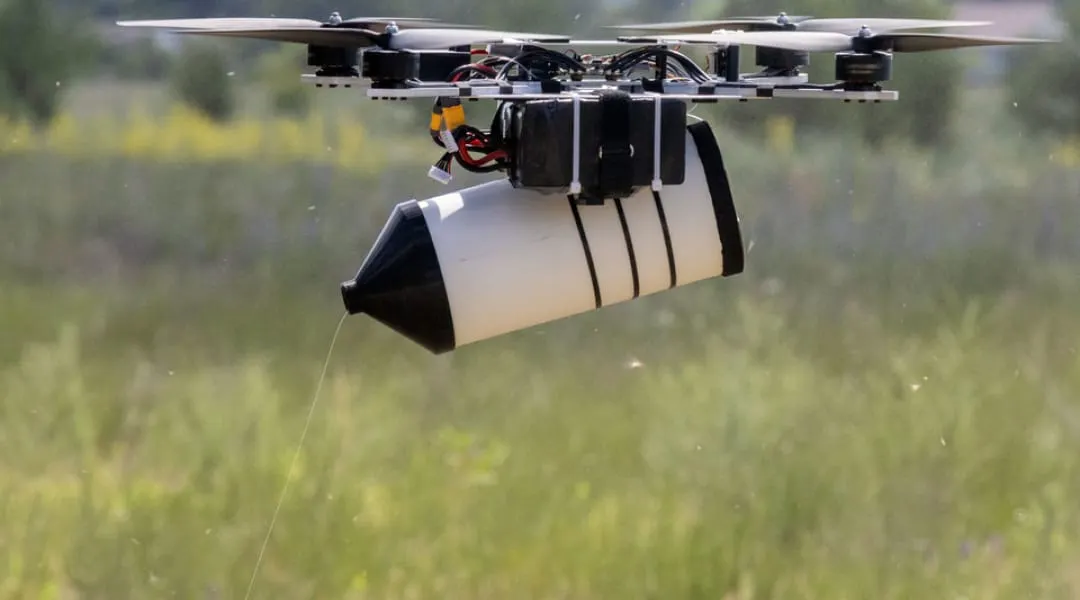
For three years Moscow's theory of victory rested on mass: more men, more shells, more glide bombs than Ukraine could absorb. Ukrainian innovation in mid- and long-range drones has quietly dismantled that advantage.
The numbers behind the manpower squeeze are stark. According to Ukrainian officials cited by the FT, Russia has for nearly half a year been losing men on the battlefield faster than it can recruit replacements. Russian budget data points the same way: about 71,200 recruits in the first quarter of 2026, down from roughly 89,600 a year earlier, per Janis Kluge of the German Institute for International and Security Affairs.
"Robotification has made troop numbers much less important," one person involved in Ukraine's war effort told the FT. "You need 10 or 20 thousand drone operators, not hundreds of thousands of men sitting in trenches."
This is the part to treat carefully. Drones have not made manpower irrelevant; they have raised the cost of moving it, supplying it and concentrating it. That is a different, and arguably more decisive, kind of advantage.
The new front line is the supply line
The most consequential development in the reviewed material is not on the contact line at all. It is roughly 50–150 km behind it, along the roads and bridges feeding occupied southern Ukraine and Crimea.
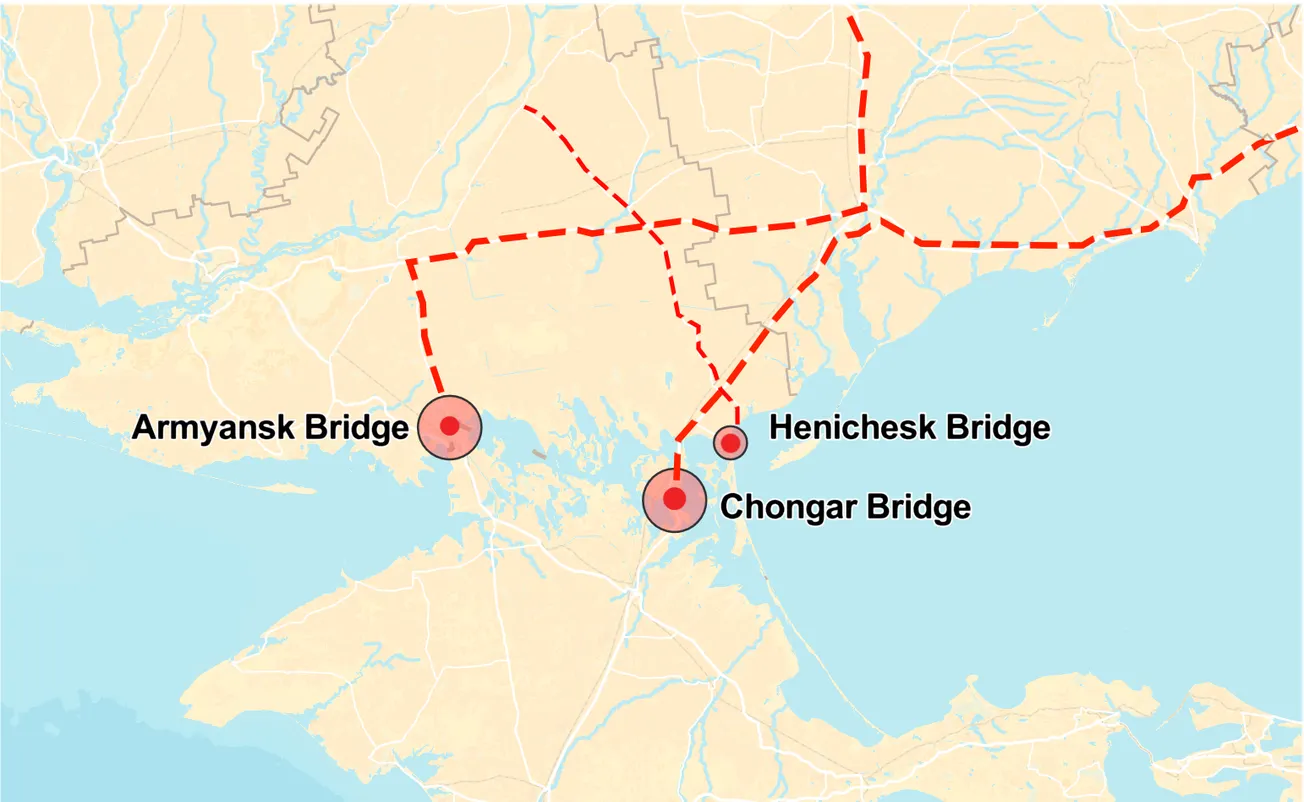
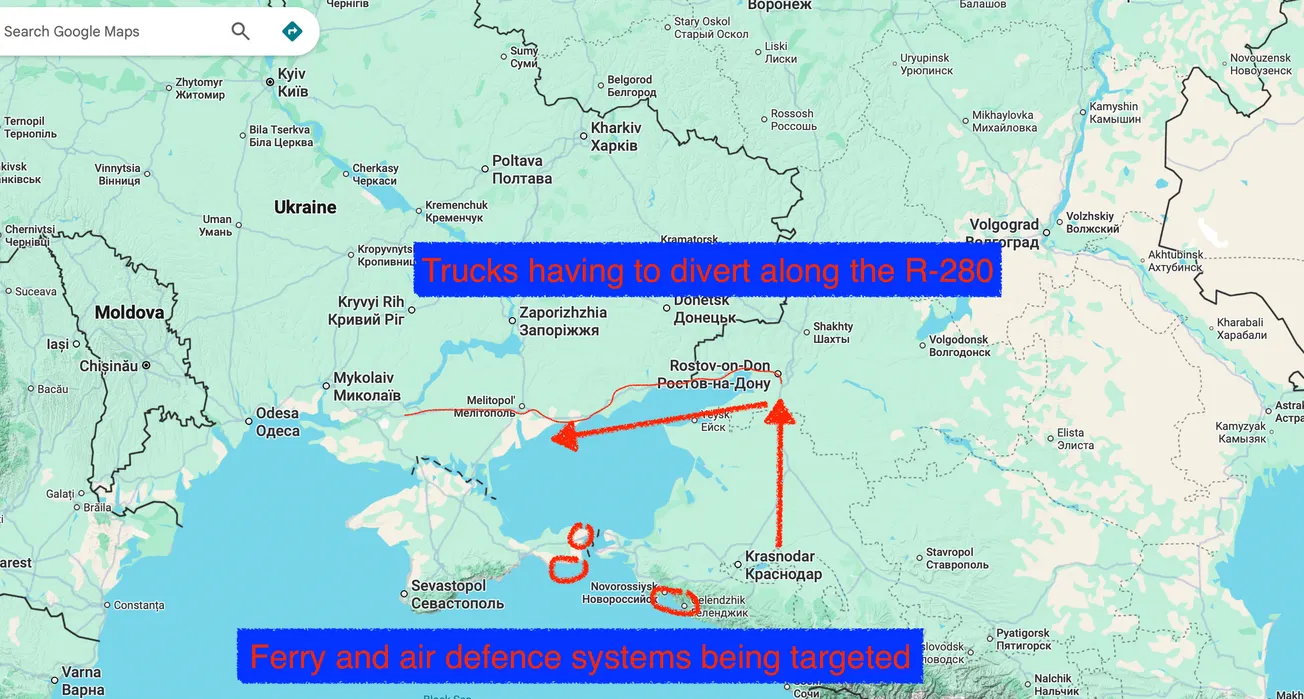
Through June, ISW reports, Ukrainian forces have systematically struck the crossings linking occupied Kherson Oblast to Crimea. Open-source satellite analysis cited by ISW found the Henichesk bridge reduced to a single lane with trucks barred; the Chonhar bridge down to one lane for light vehicles, with military equipment forced onto nearby pontoons; and a North Crimea Canal road bridge near Armyansk critically damaged, prompting Russia to build a makeshift crossing over the drained canal.
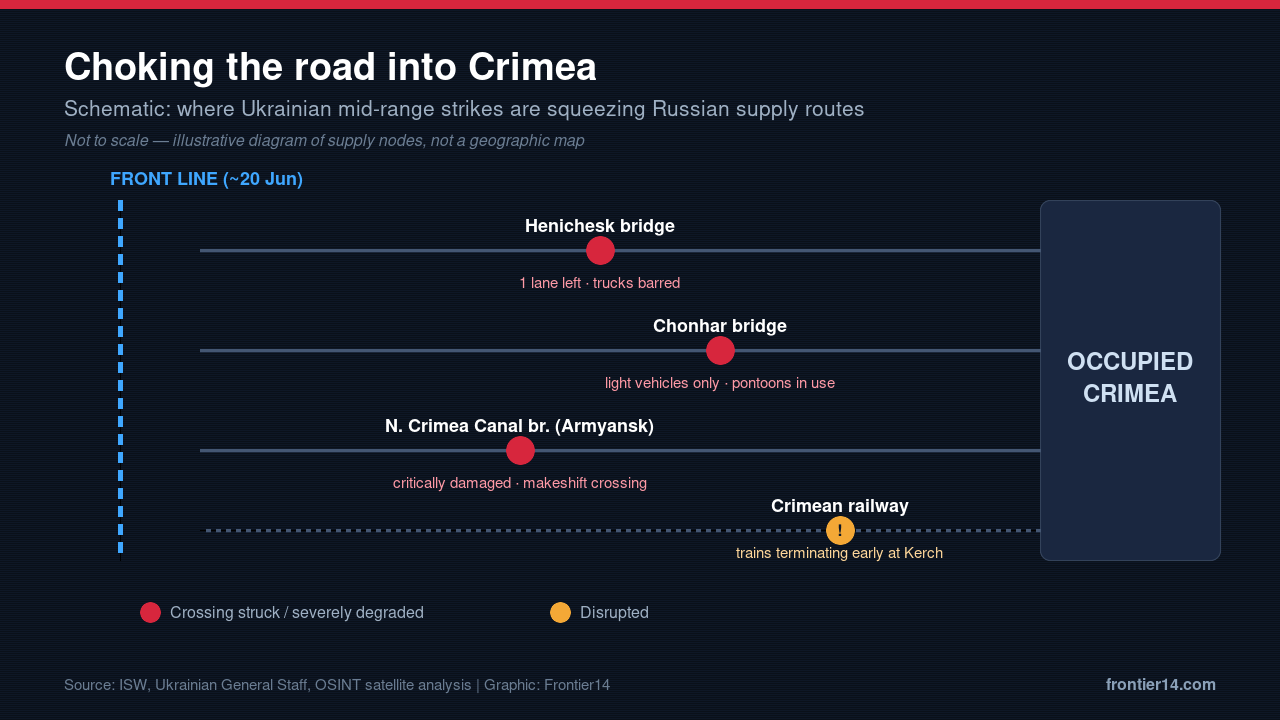
The effect is already visible in how Russia operates. A Ukrainian artillery commander told ISW that Russian logistics across the entire east bank of Kherson Oblast are increasingly difficult, hampering efforts to stockpile personnel, ammunition and supplies near the front. A Russian rail operator announced its Crimea-bound passenger trains would terminate early at Kerch because of a "temporary closure" of part of the Crimean railway. And a Russian milblogger posted images of mobile fire teams now escorting fuel tankers on the drive into Crimea, an admission, in pictures, that the land corridor is no longer safe.
The FT's frontline reporting matches this. Ukraine's 412th "Nemesis" drone brigade says it is "hitting trucks every day"; Russian logistics units are switching to smaller, less visible vehicles and rougher village tracks rather than the smooth R-280 highway. "It's not critical, but it is painful," one Ukrainian officer put it. That is the right register: not collapse, but cumulative strangulation.
Bringing the war home to Moscow
The campaign reaches far deeper than the southern corridor. On the night of 17–18 June, Ukraine struck Moscow City heavily, hitting the Moscow (Kapotnya) Oil Refinery for the second time in days and grounding flights at all four of the capital's airports. ISW notes Russia's own milbloggers were rattled, openly questioning the capital's air defences and accusing state media of manufacturing a reality in which "everything is fine." Ukrainian strikes have also reached an oil refinery in Tyumen, some 2,000 km from the border.
Two things matter here. First, even by Russia's own claimed ~90% interception rate, enough drones are getting through to cause real damage, evidence Ukraine's drones are now potent enough that small numbers landing still bite. Second, there are signs of strain in Russia's defences: CBS News, citing Ukrainian officials, reported a shortage of S-300 interceptor missiles, with insufficient guidance seekers and control modules.
The limits and Russia's one remaining edge
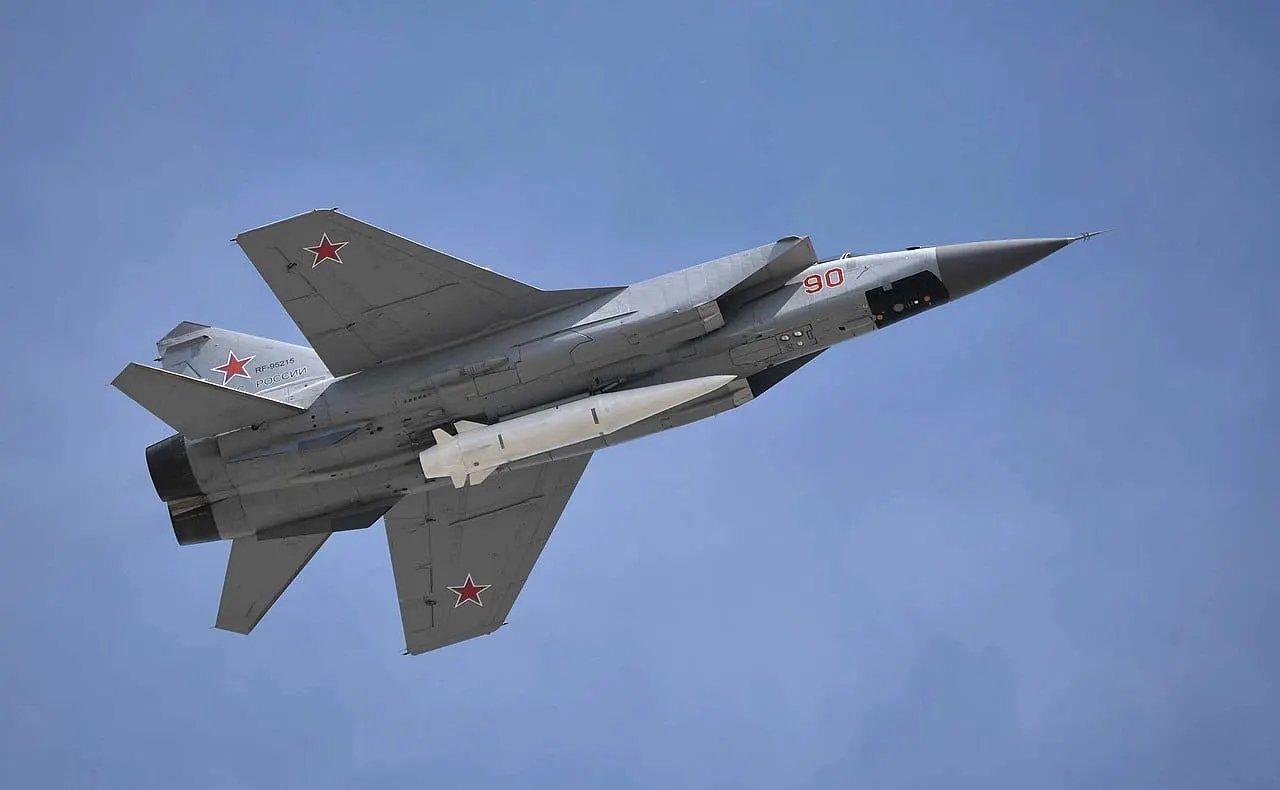
None of this means Ukraine is winning the war, and the material is clear on the counterweight. Russia retains the capacity to inflict severe damage, above all through glide bombs: Soviet-era KABs fitted with guidance kits, launched in growing numbers from jets. Ukraine's shortage of anti-air systems lets Russian planes release them closer to the front, with punishing accuracy. Russia is projected to drop more than 75,000 guided bombs this year, up from about 60,000 in 2025.
That tactic is still working in one place: Donbas. Russian squads have ground into Kostyantynivka, infiltrating "from all sides" according to the monitoring group DeepState, using glide bombs to flatten positions before infiltrating infantry one by one. But outside Donbas, Russian advances have been "nearly absent," with Ukraine mounting localised counterattacks.
Russia's own industry, meanwhile, has hit a ceiling. Record-low unemployment makes skilled drone-production workers hard to find; output has plateaued outside unmanned systems and long-range weapons. "They maxed out all their capacity," one Western intelligence official told the FT. "There's no way to step it up without investment and that takes years." Moscow's elite Rubikon drone unit, the FT reports, has so far failed to match Ukraine's mid-range capability.
What it means
Frontier14's analysis of the reviewed material points to a war settling into a new shape: a near-stalemate on the ground, decided less by who holds which tree line than by who can move fuel, shells and men without losing them to drones.
In that contest Ukraine has, for now, the initiative behind the lines, degrading the logistics Russia needs to prepare offensives, not just to fight them. Russia's answer is to bomb harder and recruit faster for drone units, while leaning on the one weapon Ukraine still cannot reliably stop.
The wider picture is a Kremlin that, on the available evidence, has run out of new tools without finding replacements, and a battlefield where the decisive question for the coming months is logistical, not territorial. As one analyst told us, barring a fresh mobilisation or escalation, there is little Russia can do to change the trajectory. The development fits a broader pattern across the reviewed reports: a war increasingly won or lost in the rear.