Table of Contents
A peace deal that depends on the Strait of Hormuz staying open is not really a peace deal. It is a standoff.
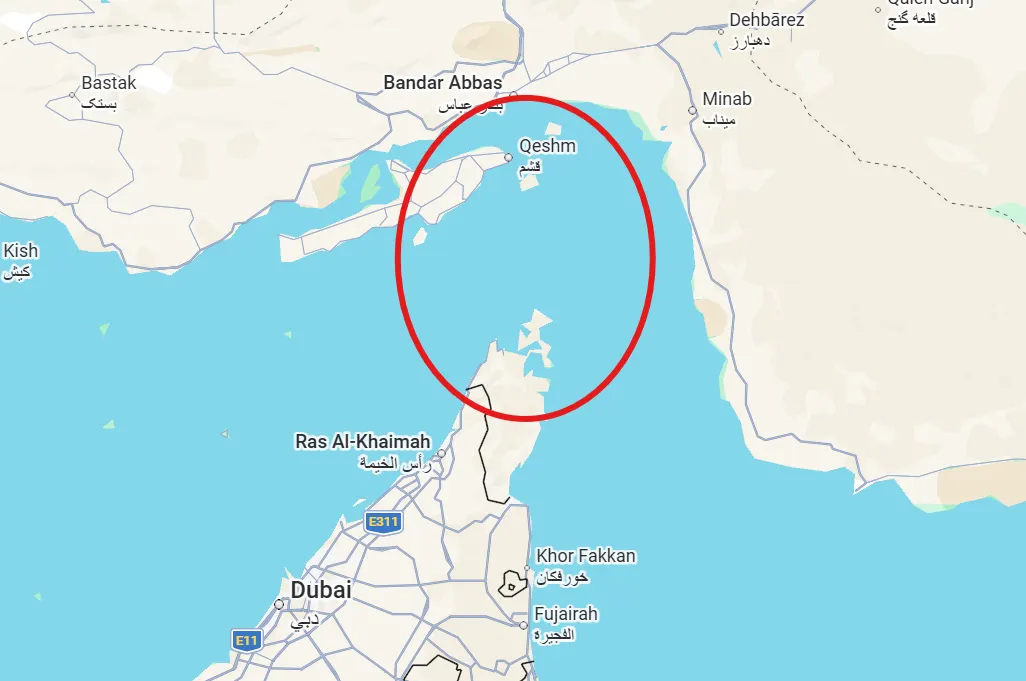
That is the clearest way to read events in the Gulf this weekend. On 20 June, Iran’s Revolutionary Guards announced they were again closing the Strait of Hormuz in response to Israeli strikes on Hezbollah in Lebanon. The waterway carries roughly a fifth of the world’s oil and gas.
A day later, a senior Iranian delegation arrived in Switzerland to implement the memorandum of understanding that the closure appeared to violate.
Both things are true at once. That is the point.
What happened
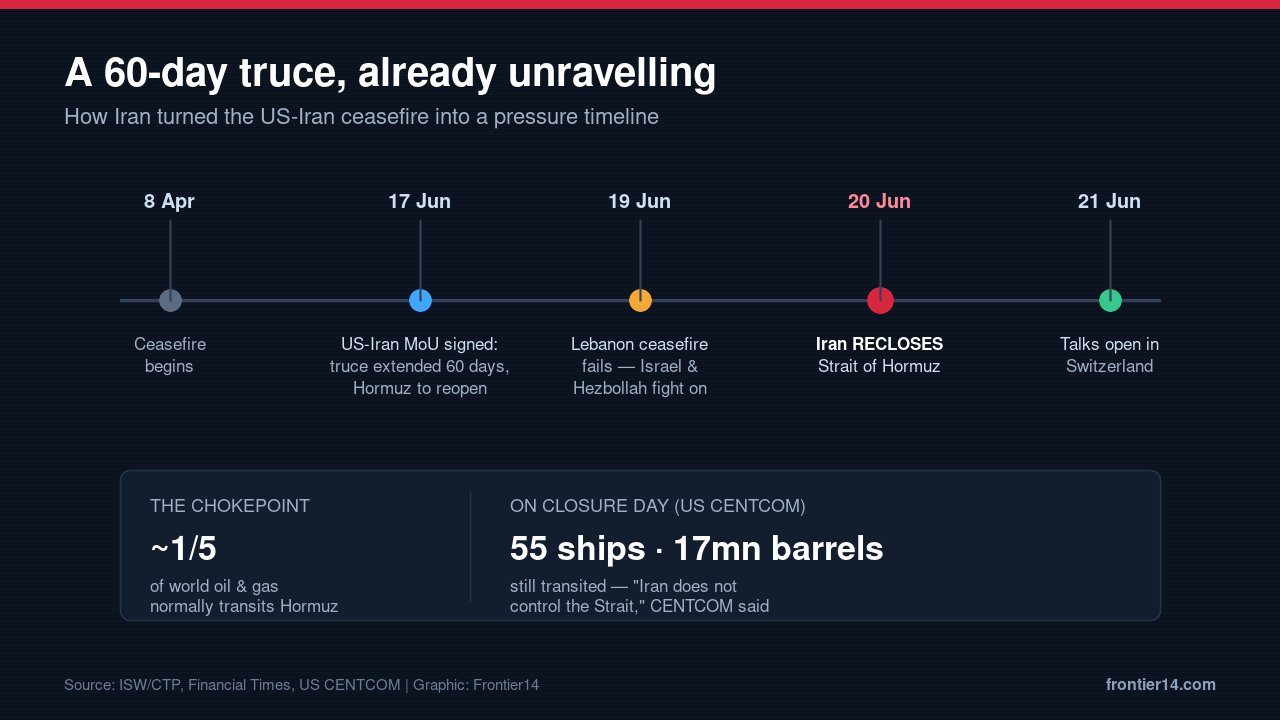
The US and Iran signed an MoU on 17 June extending the 8 April ceasefire by 60 days. Under the deal, Iran would gradually reopen Hormuz and stop charging transit fees. Washington would lift its naval blockade of Iranian ports, an order Donald Trump has already issued. Nuclear talks were meant to follow in Switzerland.
But the talks did not come first.
Tehran refused to send negotiators while Israel continued striking Hezbollah, its most important regional proxy. A US, Qatar and Iran brokered ceasefire in Lebanon on 19 June quickly broke down. Israel said Hezbollah fired more than 50 projectiles overnight. Lebanese authorities put the two day death toll in the dozens, with the wider conflict passing 4,000 dead.
Then came Iran’s Hormuz announcement.
Only after heavy lobbying by Qatari and Pakistani mediators did Tehran agree to send a delegation to the Bürgenstock resort.
The composition of that delegation matters. Alongside parliament speaker Mohammad Bagher Ghalibaf and foreign minister Abbas Araghchi, Iran sent its central bank governor and a deputy oil minister.
That points to the real agenda: sanctions relief, frozen assets, oil exports and economic leverage. Not a rush to settle the nuclear file.
Sources told Frontier14 the talks are being treated less as a final settlement and more as a way to manage pressure across several fronts at once.
Why it matters
Iran does not need to physically shut Hormuz to make the point.
US Central Command said traffic continued moving, with 55 merchant ships and more than 17mn barrels of oil transiting on the day of the closure announcement. It also said plainly that Iran does not control the Strait.
But the announcement alone changes the calculation for shippers, insurers and energy markets. Risk goes up. Prices move. Washington feels the pressure.
That appears to be the point.
Iran is using two levers it still controls: the perception of risk around Hormuz and the instability of the Lebanon ceasefire. One threatens global energy flows. The other keeps pressure on Israel and the US without requiring Tehran to move directly to the nuclear track.
For Trump, reopening Hormuz is not just a foreign policy issue. It is a domestic economic problem. The earlier closure helped push US pump prices to their highest point of either Trump term and drove inflation to a near three year high. That matters with the midterms approaching.
Iran knows this.
Washington’s problem
The sharpest criticism has come from inside US politics.
Rahm Emanuel, Obama’s former chief of staff and former ambassador to Japan, called the agreement “the memorandum of misunderstanding” and said Trump “just got schooled.”
His argument is not just partisan. Before the war, Iran was under pressure from a broken economy and domestic unrest. Now the regime has shown it can survive US strikes, keep its network active and disrupt the global economy.
Emanuel called it “the single worst American national security mess I’ve ever seen”, adding that there was “a lot of competition for it.” He also floated US sanctions on Israel, describing Benjamin Netanyahu’s government as diplomatically and strategically isolated despite its military strength.
His broader point is difficult to ignore. The war may have given Iran leverage it did not previously have.
The cracks inside Iran
That does not mean Tehran is united.
The IRGC aligned outlet Tasnim criticised Araghchi’s trip to Switzerland, saying there was “no justification” for talks while the US had not secured a full ceasefire. The delegation is unlikely to have travelled without senior approval, but the criticism shows there is pressure inside the regime too.
The logic for going is still clear. Iran is already receiving relief under the MoU and does not want to look like the side killing the process. It can collect economic gains now while keeping the nuclear file unresolved.
That sequencing works in Tehran’s favour.
Sources told Frontier14 the concern among officials watching the talks is that Iran may use the 60 day window to bank economic concessions first, then resist serious movement on the nuclear issue later.
Who benefits
The disruption also has winners.
European gas prices have risen sharply since February and Brent averaged around $103 a barrel in the three months to May. That has handed a windfall to non Gulf producers, including Norway’s Equinor, whose shares have climbed strongly.
It is a reminder that every energy shock creates both victims and beneficiaries. Trump needs Hormuz reopened. Europe needs supply security. Iran needs leverage.
That makes the Strait more than a maritime chokepoint. It is now the centre of the negotiation.
What comes next
The talks are expected to move slowly.
Mediators want to begin with a mechanism for tracking ceasefire violations in Lebanon, then move to Hormuz, then the nuclear file. Even that first step is difficult because both Israel and Hezbollah are likely to accuse the other side of firing first.
The nuclear question remains the largest issue and the least resolved. Iran has more than 9,000kg of enriched uranium, including around 440kg near weapons grade. The MoU sets only a minimum process for dilution under IAEA supervision. There is still no sign Tehran is prepared to make a serious concession on the core issue.
That is why the deal looks less like a settlement than a managed standoff.
Lebanon is the trigger. Hormuz is the lever. The nuclear file is the issue being pushed to the back of the queue.
For Iran, that order appears to work. The key question now is whether Washington can separate the Lebanon ceasefire from the economic and nuclear tracks, or whether Tehran has already managed to fuse them together.