Airlines Caught in the Crossfire: How the Middle East War Is Shaking Global Aviation
The airline sector is facing its most serious disruption since Covid, with the war in the Middle East grounding flights, erasing more than $50bn from the market value of major carriers, and prompting concerns over possible fuel shortages.
Now entering its fourth week, the conflict is causing growing anxiety across an industry highly vulnerable to sustained high oil prices, disruption at Gulf hub airports, and weakening passenger demand worldwide.
Travellers well beyond the Gulf are likely to see fares rise sharply in the months ahead as airlines try to protect margins. Jet fuel, which makes up around a third of airline costs, has surged since the US and Israel began striking Iran last month and continues to climb.
While many airlines have some protection against oil-price volatility through hedging, executives say the speed and scale of the increase in jet fuel costs will still leave them with little option but to raise prices.
EasyJet chief executive Kenton Jarvis noted that fuel prices also jumped after Russia’s invasion of Ukraine in 2022, but said this latest spike has been even more severe, describing the current turmoil as the industry’s biggest shock since aviation ground to a halt in 2020.
Investor unease has been clear. Since the war began, the 20 biggest listed airlines have shed roughly $53bn in combined market value, according to Financial Times estimates.
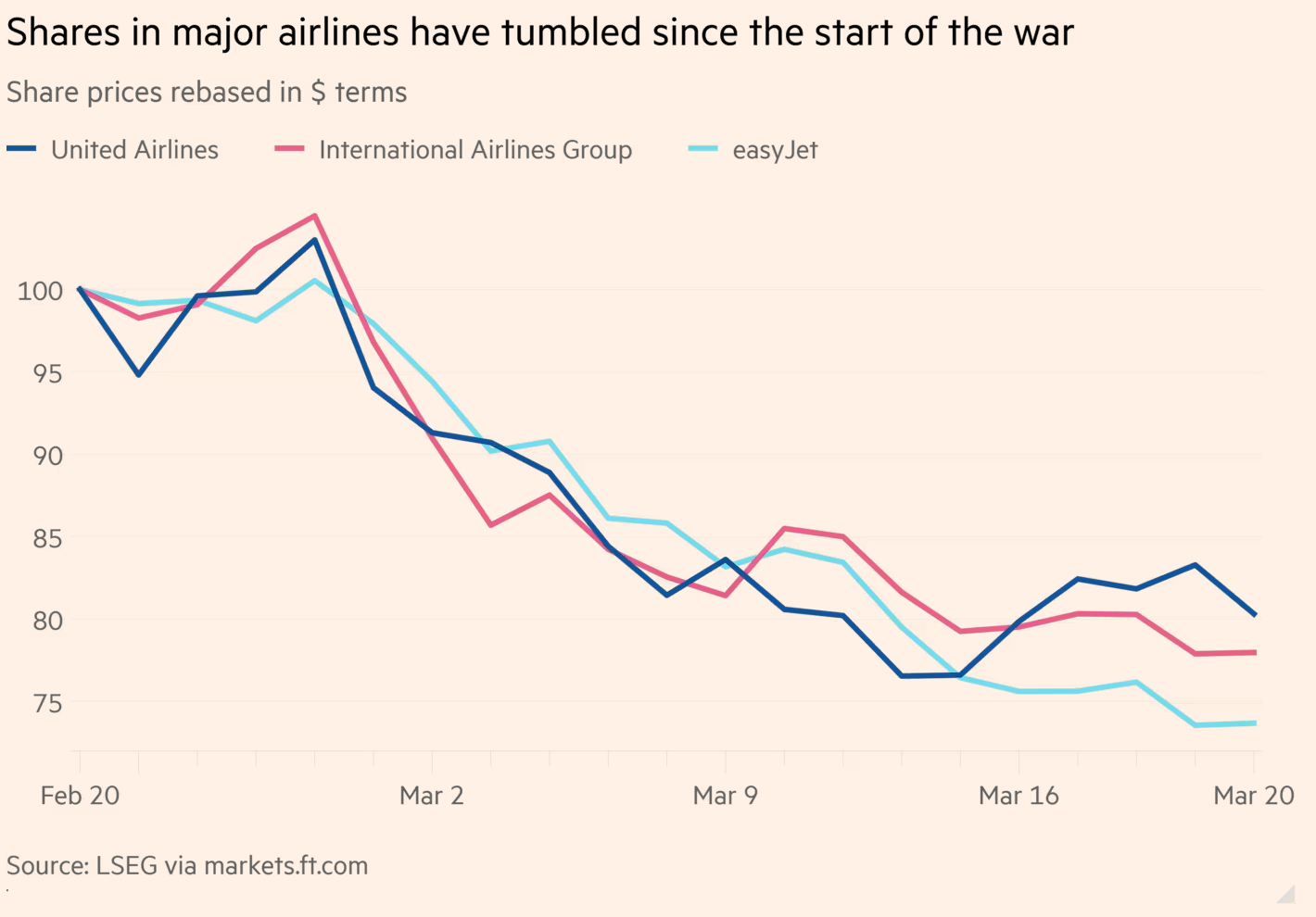
Some investors are also positioning for further declines, with Wizz Air now the most shorted stock on the FTSE 100 and easyJet also under pressure.
This crisis has hit just as airlines were benefiting from a prolonged post-pandemic recovery, with several enjoying record profits. Even so, executives are increasingly concerned that customers may not tolerate significantly higher ticket prices.
Lufthansa chief executive Carsten Spohr said fare increases are unavoidable, even if they risk weakening demand over time.
He argued that with profit margins averaging only around €10 per passenger, airlines simply cannot absorb these extra fuel costs themselves.
The turmoil is also forcing companies to prepare for more extreme scenarios, including the possibility of jet fuel shortages.
Ben Smith, chief executive of Air France-KLM, said the group was developing contingency plans for any supply squeeze, including reducing flights to parts of Asia.
Industry figures say the worst effects are being felt in the Gulf, where Emirates, Etihad and Qatar Airways have all had to cut schedules heavily because of airspace restrictions and the collapse in regional tourism.
Willie Walsh, head of Iata and former BA chief, said the situation is particularly severe for Middle Eastern airlines, though still not on the scale of the pandemic. He compared it more closely to the post-9/11 slump in transatlantic travel demand.
Andrew Charlton of Aviation Advocacy said the scale of the shock means Gulf flag carriers may need financial support from their state owners, warning that airlines without state backing could struggle badly.
The disruption has also spilled into air freight. As shipping routes are hit, more cargo is being redirected onto planes, putting pressure on airports and logistics systems.
At Geneva airport, for example, some goods are now being trucked to Paris because outbound aircraft are already at capacity, according to operations chief Giovanni Russo.
Despite the turmoil, Jarvis said he believes airline share prices could recover quickly once the war ends, adding that short sellers may rush to exit their positions if a ceasefire is announced.